
Summary: apo-nid336372.pdf
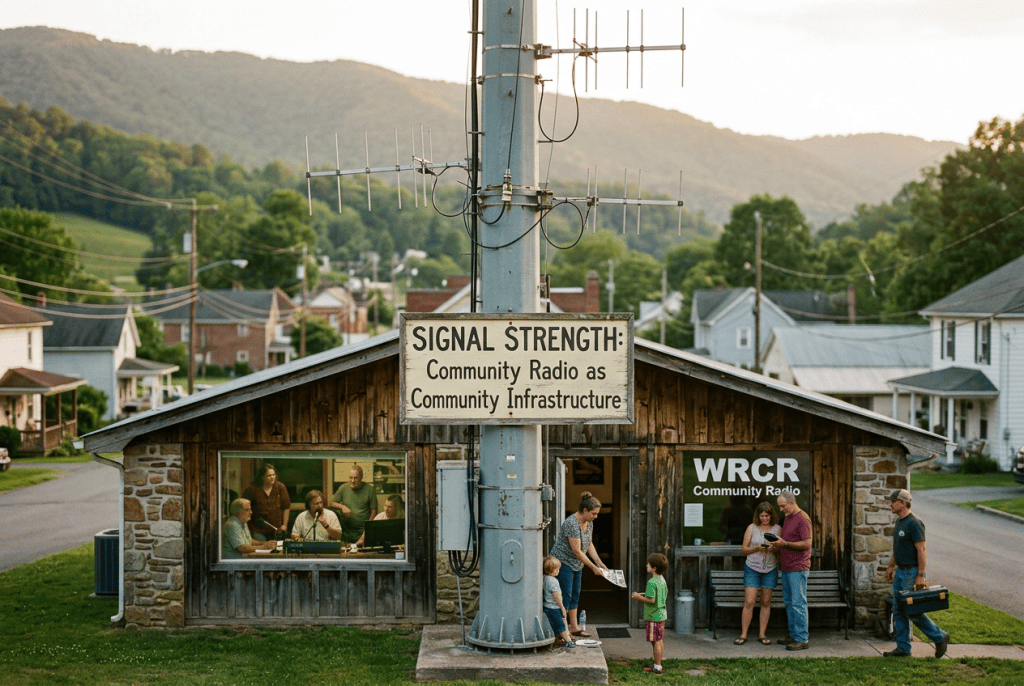
Core message: When community radio thrives, communities thrive with it.

Executive Summary
This preliminary research report from Dr Bridget Backhaus and Dr Nat Kassel at Griffith University argues that community radio is far more than a media platform. It functions as critical community infrastructure that supports social cohesion, cultural participation, democratic engagement, emergency communication, and community wellbeing across Australia.
Based on analysis of 25 policy documents, interviews with sector peak bodies, and 40 interviews with community radio practitioners, the report finds that community radio delivers substantial value despite operating with limited resources and heavy reliance on volunteers.
Key Findings
1. Community radio is vital community infrastructure
The report describes community radio as a largely under-recognised public asset that:
- Provides local news and information, particularly in areas experiencing “news deserts”.
- Supports Australian musicians, artists and local cultural ecosystems.
- Creates spaces for diverse, marginalised and under-represented voices.
- Supports communities during emergencies and disasters with trusted local information.
- Helps communities recover, heal and reconnect after crises.
- Builds social cohesion and civic participation.
The report notes that Australia has more than 500 community broadcasting services reaching over five million weekly listeners.
2. Significant benefits for volunteers and audiences
Community radio provides strong personal development outcomes for volunteers and staff, including:
- Increased confidence and self-efficacy.
- Technical, communication and leadership skills.
- Professional networking opportunities.
- Improved wellbeing and sense of purpose.
- Greater community connection and belonging.
For audiences, community radio:
- Reduces social isolation, especially for older Australians.
- Supports cultural identity and language preservation.
- Provides authentic, locally relevant content.
- Offers human connection that algorithms and streaming platforms cannot replicate.
3. Funding remains the sector’s biggest challenge
The strongest and most consistent issue raised was inadequate funding.
Challenges include:
- Dependence on short-term grants.
- Constant fundraising and sponsorship efforts.
- Difficulty planning strategically beyond short funding cycles.
- Regional and smaller stations being especially vulnerable.
The report notes that government grants account for only around 7.5% of total sector funding, while volunteers contribute labour valued at approximately $250 million.
4. Workforce sustainability is a growing concern
Key workforce risks identified include:
- Volunteer shortages.
- Volunteer burnout.
- Difficulty attracting board members and governance expertise.
- Dependence on a handful of highly skilled technical volunteers.
- Challenges recruiting and retaining younger volunteers.
Several participants argued for more paid positions, particularly within First Nations broadcasting, where unpaid labour was often viewed as inappropriate or unsustainable.
5. Community radio is an important training ground
The sector functions as an informal training pathway into:
- Journalism.
- Broadcasting.
- Media production.
- Creative industries.
However, many stations experience “skills bleed”, where they invest heavily in training volunteers who then move into commercial or public media roles.
The report suggests community broadcasting should be recognised not only as a pathway into media careers but also as a legitimate career destination in its own right.
6. Digital transformation presents both risks and opportunities
The report rejects the idea that radio is dying.
Instead, community broadcasters believe the medium is evolving through:
- Podcasts.
- Streaming platforms.
- Social media content.
- Digital engagement initiatives.
The challenge is acquiring the resources, technology and skills needed to adapt while retaining the live, local and community-focused strengths that distinguish community radio.
7. The sector suffers from low visibility
A major theme was that community radio’s value is not widely understood outside the sector.
The report found:
- Many communities are unaware their local station exists.
- Governments and organisations often underutilise community radio partnerships.
- Stations struggle to communicate their social impact.
- Greater national promotion and advocacy are needed.
Main Recommendations
For individual stations
- Expand community engagement beyond traditional broadcasting.
- Better document and promote success stories.
- Celebrate station alumni and career pathways.
- Improve succession planning.
- Formalise partnerships with community organisations.
- Diversify revenue sources.
- Assess and manage volunteer burnout risks.
For the sector
- Increase technical support and infrastructure investment.
- Advocate for recognition of community radio as a workforce development pathway.
- Strengthen partnerships with universities and training organisations.
- Expand investment in emergency broadcasting capability.
Communications Takeaway
For communications professionals, the most useful insight is that the report reframes community radio not as a niche media outlet but as community infrastructure. Its value proposition extends beyond audience reach to include social connection, civic participation, emergency preparedness, cultural preservation, skills development, and community resilience. The report suggests that governments and organisations could achieve greater community impact by treating community radio as a strategic partner rather than simply another media channel.
Core message: When community radio thrives, communities thrive with it.



Charlie would love to start the conversation with you…